

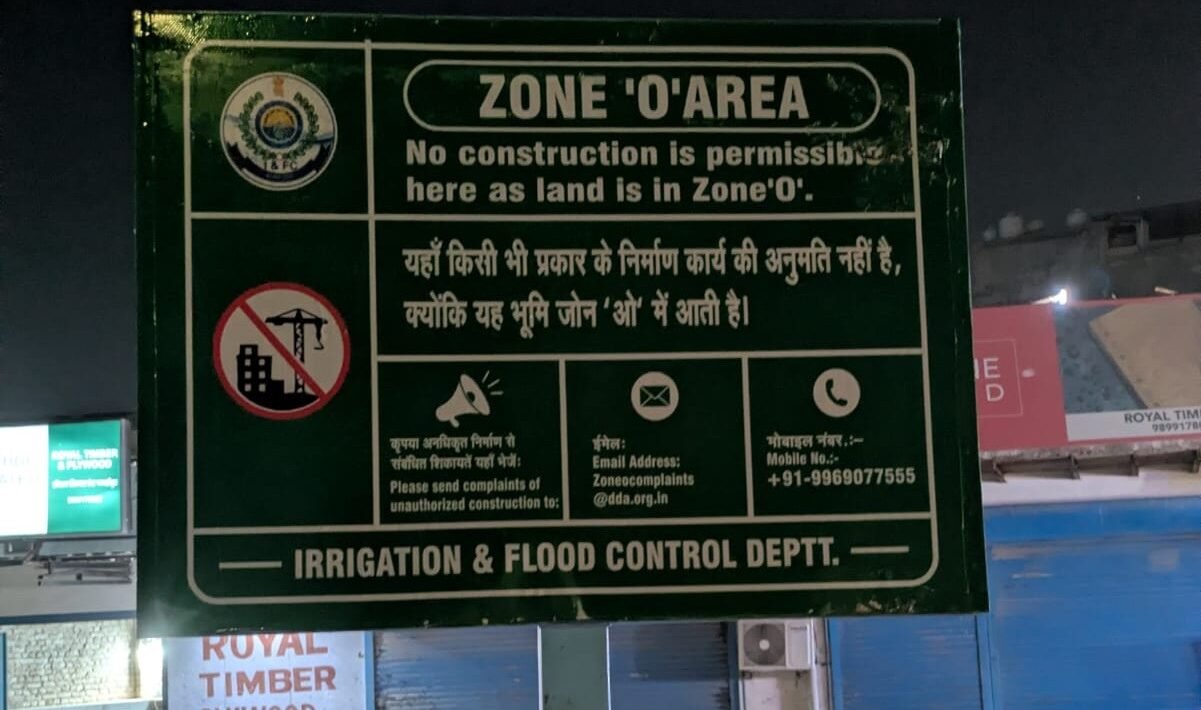
The recent judgment of the Delhi High Court on unauthorised colonies in Zone ‘O’ along the Yamuna floodplains may well become one of the most consequential urban-environment decisions in the capital’s recent history. Delivered by the bench of Justice Prathiba M. Singh and Justice Manmeet Pritam Singh Arora, the ruling does not merely address illegal construction. It raises a deeper and uncomfortable question: can Delhi continue to sacrifice its ecological lifeline in the name of unchecked urbanisation?
The Court’s observations were blunt. Residential colonies on the Yamuna floodplains are “impermissible” and environmentally destructive. The judges reminded authorities that Zone ‘O’ is not ordinary land—it is part of the river’s natural floodplain, crucial for groundwater recharge, flood absorption, and ecological balance. Yet over the years, this fragile zone has transformed into a sprawling network of illegal colonies, commercial structures, and encroachments, often flourishing under administrative negligence and political silence.
What makes the judgment especially significant is its refusal to allow ambiguity. For months, different government agencies appeared uncertain about whether unauthorised colonies in Zone ‘O’ enjoyed protection under the National Capital Territory of Delhi Laws (Special Provisions) Act. The Court repeatedly questioned the unclear stand taken by the Ministry of Housing and Urban Affairs. Finally, the Centre clarified that while these colonies may receive temporary protection from punitive action until December 31, 2026, they are not regularised and no ownership rights are being granted.
This distinction is critical. Protection is not legalisation. The Court has effectively warned residents, land dealers, and even government officials that the floodplains cannot become permanent real estate settlements.
At the same time, the judgment is not blind to human realities. Nearly five to six lakh people are estimated to be living across 91 colonies in Zone ‘O’. These are not merely statistics. They represent families, migrant workers, small businesses, and generations who settled there due to Delhi’s chronic housing failures. The Court acknowledged that rehabilitation and long-term planning would be necessary before any decisive action could take place.
This is where the judgment acquires moral complexity. Environmental protection and humanitarian concerns are colliding head-on. Delhi cannot afford to lose the Yamuna floodplains, especially after repeated flooding warnings, pollution crises, and climate-related urban disasters. At the same time, the city also cannot pretend that lakhs of residents simply appeared overnight. Illegal colonies thrive because affordable housing policies have consistently failed the urban poor.
The Court’s anger toward civic authorities is equally noteworthy. It openly criticised the continuation of fresh illegal construction despite ongoing monitoring and court proceedings. Photographs submitted before the bench showed new construction activities in areas like Wazirabad, Jagatpur, and Majnu Ka Tila continuing “right under the supervision” of municipal engineers. The Court has now sought accountability from Executive Engineers and other officials responsible for enforcement failures.
In many ways, this reflects Delhi’s larger governance crisis. Illegal construction in the capital is rarely possible without administrative complicity. Every encroachment on public or environmentally sensitive land survives through a chain of silence involving local officials, political patronage, and weak enforcement. The judiciary has once again stepped into a space where executive agencies failed to act decisively.
The judgment also aligns with a growing judicial push to protect the Yamuna ecosystem. In recent weeks, the High Court has barred commercial and religious activities on sensitive Yamuna floodplain areas, stressing that ecological preservation must take precedence over convenience or commercial interests.
However, courts alone cannot restore the Yamuna. Delhi needs a long-term floodplain policy rooted in science, transparent rehabilitation, strict anti-encroachment enforcement, and political courage. Temporary demolitions or symbolic drives will not solve a crisis built over decades.
The High Court has delivered a warning that Delhi can no longer ignore. The Yamuna floodplains are not vacant land banks waiting to be occupied—they are ecological infrastructure essential for the city’s survival. If the capital continues to consume its riverbed in the name of urban expansion, future generations may inherit a city more vulnerable to floods, water scarcity, pollution, and environmental collapse. The real challenge now lies not in the courtroom, but in governance. Delhi must decide whether it wants a living river or an irreversible urban disaster.
About the Writer:
Altamash Khan is a contributing journalist who completed his journalism studies at the prestigious Aligarh Muslim University. He has over half a decade of experience writing on a wide range of topics, from politics and social issues to technology and Brands. In addition to his journalism work, he works as a Public Relations and Brand Strategist, helping communicate Brand messages to the World. He would love to hear your thoughts on this issue. Leave a comment below or reach out via the social media handles.