

TAASIR :- S M HASSAN 29 MARCH
Conclusion of the Two-Day International Conference of the Forum for Awareness of National Security; Extensive Deliberations Held on Culture, Climate, and History
New Delhi, March 29
Dr M Rahmatullah
“If India does not lead the world with the values of peace, harmony and coexistence, the world will continue to bleed and remain trapped in cycles of violence and conflict.” This was stated by Dr Indresh Kumar, senior guide and chief patron of the Forum for Awareness of National Security (FANS), while addressing the valedictory session of the two-day international conference Manthan 5.0 at the University of Delhi.
Dr Indresh Kumar highlighted the civilizational depth of India and said that the land of India reflects the depth of the Sindhu and the purity and vastness of the Himalayas. He observed that conflicts arise from ignorance, while wisdom provides solutions to every problem. Referring to Lord Rama, he said that it is rare to find anywhere in the world such widespread reverence for a name, noting that parks, buildings and many places in India are associated with the name of Rama. He further remarked that in Persia too, Lord Rama is remembered as Imam-e-Hind.
Emphasizing the importance of mother tongues, he noted that every Indian dreams in their own language, which reflects how deeply individuals remain connected to their language and cultural roots throughout life.
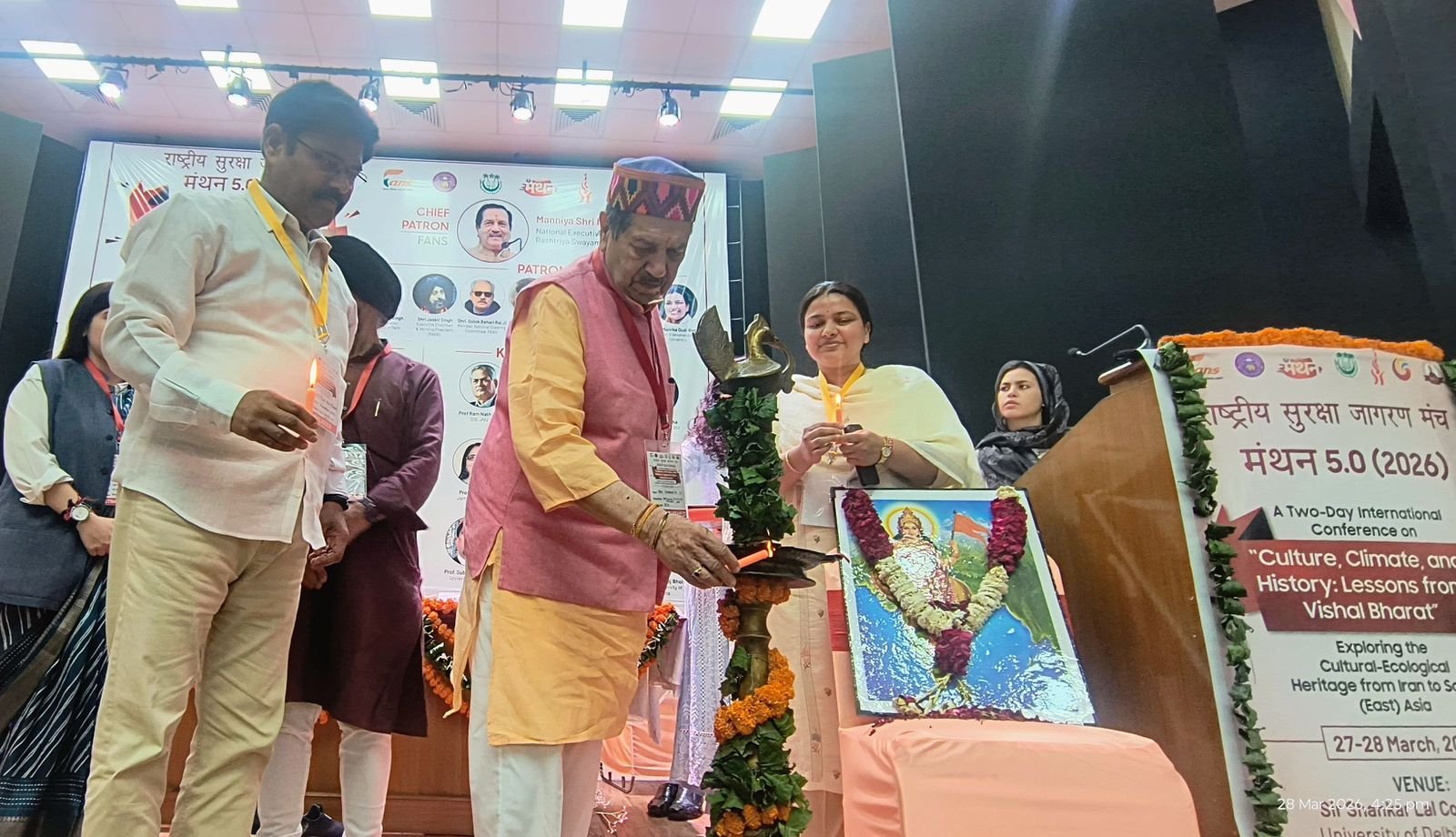
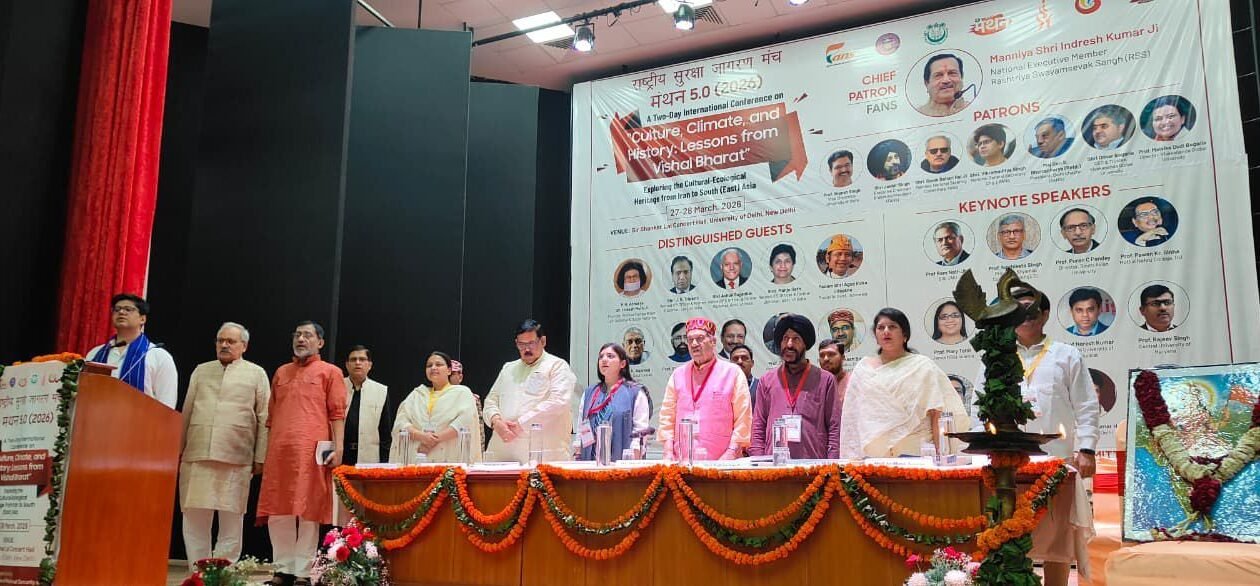
The two-day international conference was organized by the Forum for Awareness of National Security (FANS) on 27–28 March 2026 at Sir Shankar Lal Concert Hall, University of Delhi. The theme of the conference was “Culture, Climate, and History: Lessons from Greater India.” The conference explored diverse dimensions of cultural and ecological heritage extending from Iran to Southeast Asia. Five academic sessions were held during the event, in which more than one hundred research papers were presented.
The conference was jointly organized by FANS, Galgotias University, and Vivekananda Global University, Jaipur. The event also witnessed active participation from the Himalayan Studies Centre, University of Delhi, and the Centre for Peace and Conflict Resolution, Jamia Millia Islamia.
Distinguished scholars, diplomats, strategic experts, researchers and social activists from India and abroad participated in the conference and engaged in discussions on civilizational heritage, environmental perspectives and contemporary global challenges.
Presenting the session reports, Jasbir Singh, Executive President of FANS, emphasized that the younger generation should learn from significant historical events. He stated that along with remembering the 9/11 attacks in New York, young people should also remember Swami Vivekananda’s Chicago speech, as both events hold important lessons for humanity in different ways.
Prof Amrita Tyagi of Galgotias University spoke about the foundational values of Greater India, tracing them from the Indus Civilization to modern India, and emphasized the importance of the Indian knowledge system. Prof Malvika Dudi Bagaria, Chairperson of Vivekananda Global University, Jaipur, highlighted the concept of human-centric development within the framework of the Indian knowledge system.
Prof Mehtab Alam Rizvi, Registrar of Jamia Millia Islamia University, underscored the contribution of India’s Army, Navy and Air Force in safeguarding the nation. He stressed that national security is not limited to military strength but is also deeply connected to civilizational values and social cohesion. Referring to the principle of “Vasudhaiva Kutumbakam – One Earth, One Family, One Future,” he stated that historically India has not pursued aggressive expansion but has built relations with other regions through trade, culture and knowledge exchange. He cited the example of Emperor Ashoka to highlight India’s long tradition of dialogue and peaceful engagement.
Journalist and political analyst Awadhesh Kumar Singh said that it is important to envision what the concept of Greater India should look like in contemporary times. He emphasized the need for decolonization of thought, strengthening the Indian knowledge system and reinforcing civilizational resilience.
Dr Varnika Sharma, General Secretary of FANS, said that Manthan is not merely an academic event but a process of intellectual churning that must reach the grassroots so that young people can better understand Indian civilization and its values.
Devyani Singh Rana, MLA from the Nagrota constituency in Jammu and Kashmir, spoke about the importance of focusing on Indian civilization and the ongoing narrative battles in the contemporary world. She noted that social media has become a powerful medium influencing youth and shaping perceptions. She cautioned that foreign media agencies often attempt to weaken India’s civilizational identity through digital narratives, and emphasized the importance of awareness and responsible engagement on social media platforms.
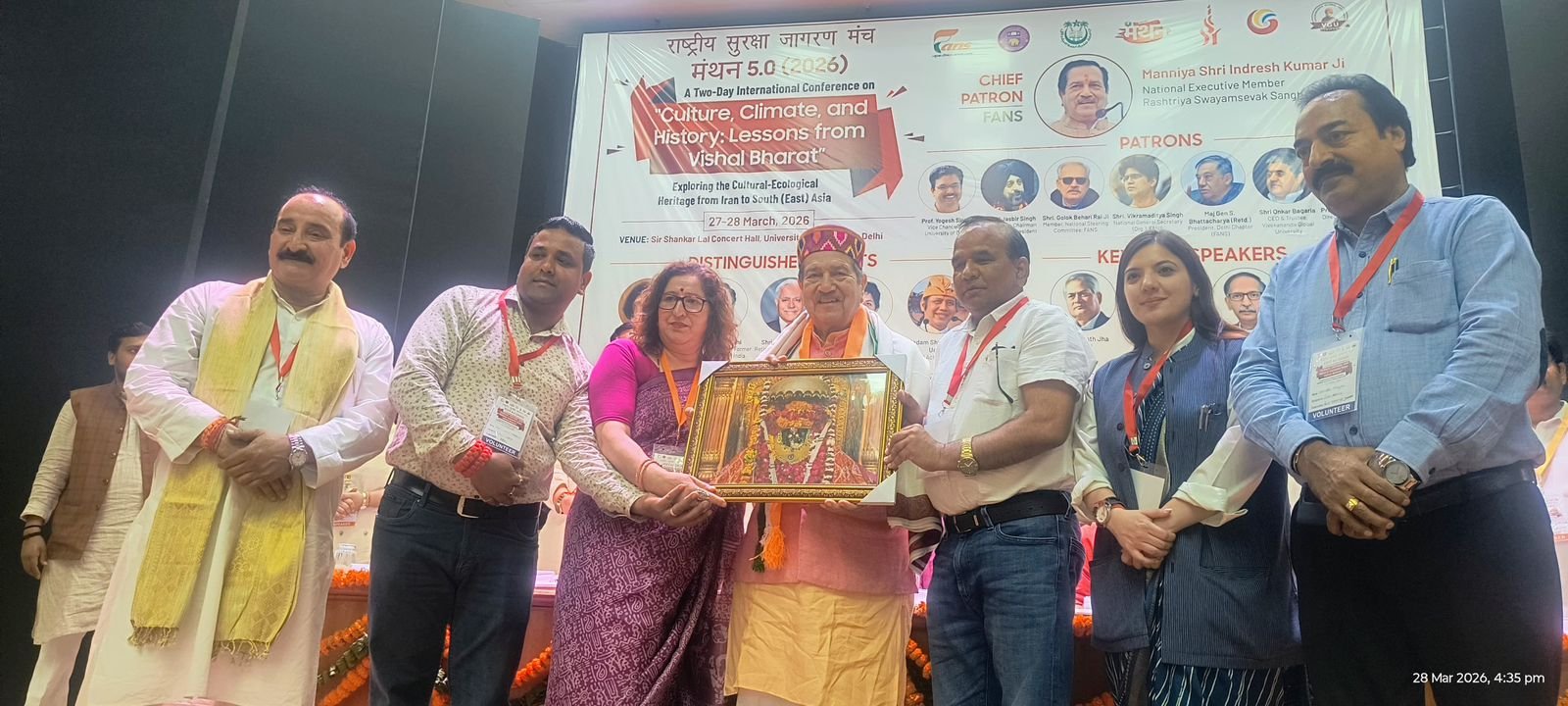
During the conference, outstanding paper presenters across the five sessions were honored, including Jyoti Bharti, Abhishek Tripathi, Ravidas, Mitakshara Tiwari, and Dr Imchin.
Among those present on the occasion were Golok Bihari Rai, member of the National Steering Committee, and Vikramaditya Singh, National Organisation Secretary of FANS. Prof Vijay Kumar served as the Conference Convener, while Chatar Singh and Dr Vivek coordinated the Manthan sessions.
The conference commenced on 27 March at 10:00 AM and concluded on 28 March at 4:30 PM. Over two days, extensive academic discussions were held on themes such as “Greater India and Global Dialogue,” “Civilizational Perspectives and Ecological Ethos of Greater India,” “Cultural Interactions in Historical Context,” “Contemporary Global Challenges and Indian Knowledge Traditions,” and “Cultural Memory, Heritage and Continuity in Greater India.”
Speakers also highlighted that historically India maintained deep cultural, educational and trade connections with East Africa, the Arab world, Sri Lanka and Southeast Asia, which helped strengthen its global identity.
The primary objective of the conference was to understand cultural, historical and ecological linkages through the idea of Greater India while encouraging meaningful dialogue on contemporary global challenges such as climate change, maritime security, energy supply routes and geopolitical competition.
The event witnessed the participation of a large number of academicians, researchers and intellectuals from India and abroad. Among those present were Golok Bihari Rai, Prof Dinesh Chandra Rai (Vice-Chancellor, Bihar University, Muzaffarpur), Dr Mohammad Hossein Ziyaeenia and Agha Haider from Iran, Prof Vijay Kumar, Prof Anil Saumitra, Dr Suresh Kumar Verma, Dr Rajeev Pratap Singh, Dr Saista Sami, Dr Varnika Sharma, and Prof Geeta Singh.
The programme concluded with a vote of thanks delivered by Chatar Singh, expressing gratitude to all the speakers, participants and organizers for making Manthan 5.0 a successful academic and intellectual gathering.