

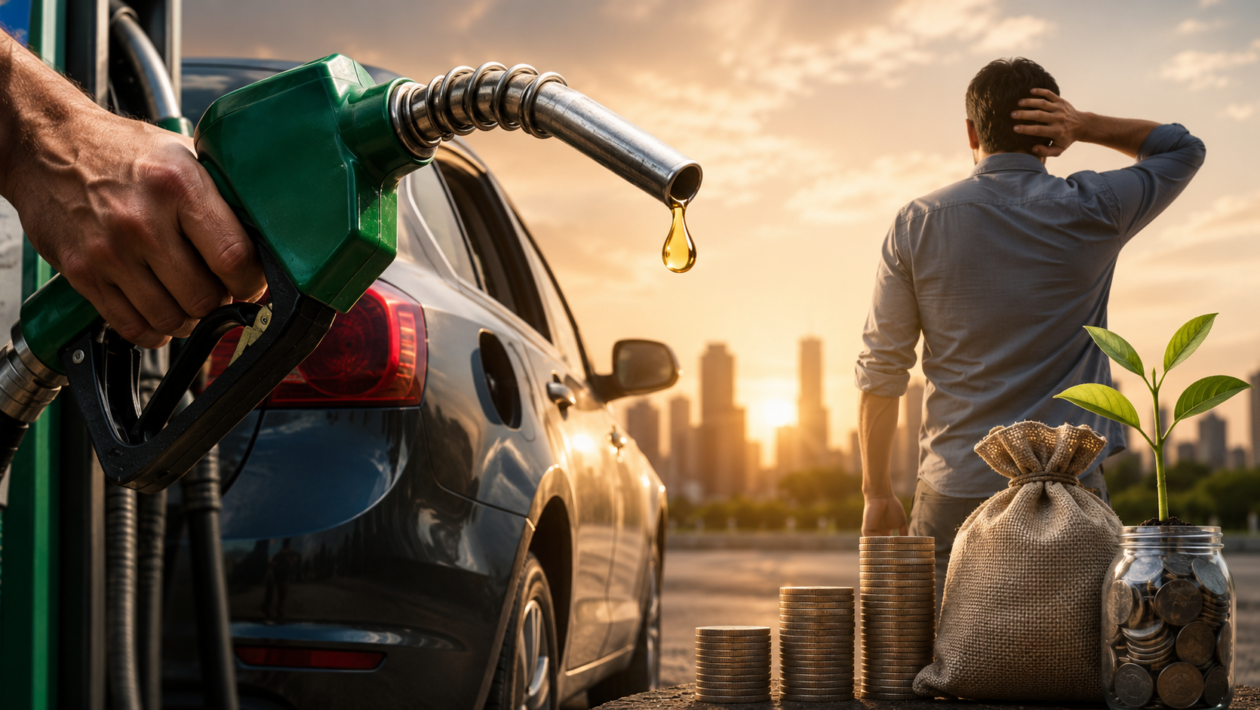
India’s ambitious push towards 20% ethanol blending (E20) in petrol is being projected as a milestone in the country’s journey towards energy security, lower crude oil imports, and reduced carbon emissions. On paper, the policy appears to be a win-win for the economy, the environment, and farmers. However, beneath the optimism lies a growing concern that is rarely discussed, the burden of transition is falling disproportionately on the common motorist, particularly those driving vehicles manufactured before 2023. At a time when fuel adulteration remains an unresolved challenge in many parts of the country, introducing a higher ethanol blend without fully addressing ground realities risks creating more problems than it solves.
For years, fuel adulteration has silently plagued India’s transport ecosystem. Mixing petrol with cheaper solvents or kerosene has caused engine damage, reduced mileage, increased emissions, and imposed recurring maintenance costs on vehicle owners. Despite periodic crackdowns, reports of adulterated fuel continue to emerge from different states. Consumers already bear the cost of poor-quality fuel without adequate mechanisms for compensation or accountability. Against this backdrop, introducing E20 fuel adds another variable into an already fragile system. Ethanol itself is not the villain. It is a renewable biofuel that burns cleaner than conventional petrol and reduces dependence on imported fossil fuels. India’s ethanol blending programme has steadily increased from negligible levels a decade ago to over 15% in many regions today. The government hopes E20 will save billions of dollars in foreign exchange while supporting the sugarcane and grain economy. These are legitimate national objectives. Yet, public policy must also consider who pays the price during the transition.
The biggest concern revolves around vehicle compatibility. Most petrol-powered vehicles manufactured in India before 2023 were designed and calibrated for E10 fuel, containing 10% ethanol. Higher ethanol content changes combustion characteristics. Ethanol absorbs moisture more readily than petrol, can affect rubber and plastic components in older fuel systems, and has lower energy density, often resulting in reduced fuel efficiency. While manufacturers have gradually introduced E20-compatible models, millions of older vehicles remain on Indian roads.
For owners of these vehicles, the transition creates uncertainty. They are asked to trust that their vehicles will continue functioning without long-term consequences, even though many automakers have issued advisories recommending caution for older models. The choice is limited because, in many areas, consumers cannot easily choose between E10 and E20 once higher blends become the default. The burden of adapting falls not on policymakers or manufacturers, but on ordinary citizens who may neither have the financial means to upgrade their vehicles nor the technical understanding to navigate compatibility issues. This becomes particularly unfair when viewed through the lens of affordability. A middle-class family that purchased a car or two-wheeler in 2018 or 2020 did so believing it would remain viable for many years. Suddenly, they face concerns over engine wear, warranty limitations, reduced mileage, and potentially higher maintenance costs,not because of misuse, but because fuel specifications have changed. The irony is difficult to ignore: citizens who complied with every regulation when purchasing their vehicles are now expected to bear additional costs for a policy shift beyond their control.
Mileage is another practical concern. Ethanol contains less energy per litre than petrol. Consequently, higher ethanol blends generally reduce fuel economy, although the extent varies across engines. Even a modest decline in mileage means consumers purchase fuel more frequently. If petrol prices remain unchanged while energy content falls, motorists effectively pay more to travel the same distance. For daily commuters, delivery workers, taxi drivers, and small business owners, these incremental costs accumulate into a significant financial burden.
The issue becomes even more complicated when fuel adulteration enters the equation. Ethanol blending requires careful storage, transport, and quality control because ethanol attracts water and behaves differently from pure petrol. If existing fuel distribution systems already struggle to prevent adulteration, maintaining consistent E20 quality becomes an even greater challenge. Without robust monitoring, consumers may face the combined risks of adulterated fuel and compatibility issues, while finding it nearly impossible to identify the root cause of vehicle problems.
There is also a communication gap. Public awareness regarding E20 remains limited. Many vehicle owners are unaware of whether their engines are compatible, what precautions they should take, or how ethanol affects performance. Information is often scattered across manufacturer websites, dealership advisories, and government announcements rather than being presented through a unified consumer education campaign. A policy affecting millions deserves transparent communication rather than assumptions that consumers will adapt on their own.
None of this suggests India should abandon ethanol blending. The country’s long-term energy strategy must diversify beyond imported crude oil, and biofuels have an important role to play. However, successful transitions require fairness. Governments worldwide introducing cleaner fuels have often paired policy changes with consumer incentives, phased implementation, and technological support. India must adopt a similarly balanced approach. Older vehicle owners deserve practical solutions: continued availability of lower ethanol blends during the transition, clear compatibility labelling at fuel stations, affordable retrofit options where feasible, independent fuel quality audits, and stronger action against adulteration. Automobile manufacturers should also play a greater role in educating customers and offering technical support instead of merely introducing new compatible models.
The success of E20 should ultimately be measured not only by ethanol blending percentages but also by public confidence. A policy designed to benefit the nation should not inadvertently penalise those who can least afford change. Environmental responsibility and consumer protection are not competing goals, they must move together. India’s ethanol journey is an important chapter in its energy future. But if the transition is to succeed, it must carry the confidence of the people alongside the ambitions of the government. Otherwise, E20 risks becoming another well-intentioned reform whose hidden costs are quietly borne by the common citizen, one fuel tank at a time.
About the Writer:
Altamash Khan is a contributing journalist who completed his journalism studies at the prestigious Aligarh Muslim University. He has over half a decade of experience writing on a wide range of topics, from politics and social issues to technology and Brands. In addition to his journalism work, he works as a Public Relations and Brand Strategist, helping communicate Brand messages to the World. He would love to hear your thoughts on this issue. Leave a comment below or reach out via the social media handles.